LCPC pile resistance calculations
- class groundhog.deepfoundations.axialcapacity.lcpc.LCPCAxcapCalculation(depth, qc, diameter_pile, group_base, group_shaft, diameter_shaft=nan)[source]
- __init__(depth, qc, diameter_pile, group_base, group_shaft, diameter_shaft=nan)[source]
Initializes a pile base resistance calculation according to LCPC method Bustamante and Gianeselli (1982). Lists or Numpy arrays of depth and cone resistance need to be supplied to the routine as well as the diameter of the pile.
- Parameters:
depth – List or Numpy array with depths [m]
qc – List or Numpy array with cone resistance values [MPa] - same list length as depth array
diameter_pile – Diameter of the pile [m]
group_base – Pile group used for the base factors (select from
["I", "II"])group_base – Pile group used for the shaft factors (select from
["IA", "IB", "IIA", "IIB"], factors for micropiles IIIa and IIIb are not encoded)diameter_shaft – Diameter of the pile shaft, specify this only if it is different from the base diameter [m]
- calculate_base_resistance()[source]
Calculates the base resistance.
\[ \begin{align}\begin{aligned}q_b = k_c \cdot q_{ca}\\Q_b = A_b \cdot q_b\end{aligned}\end{align} \]The factors are taken according to the soil and pile type specified.
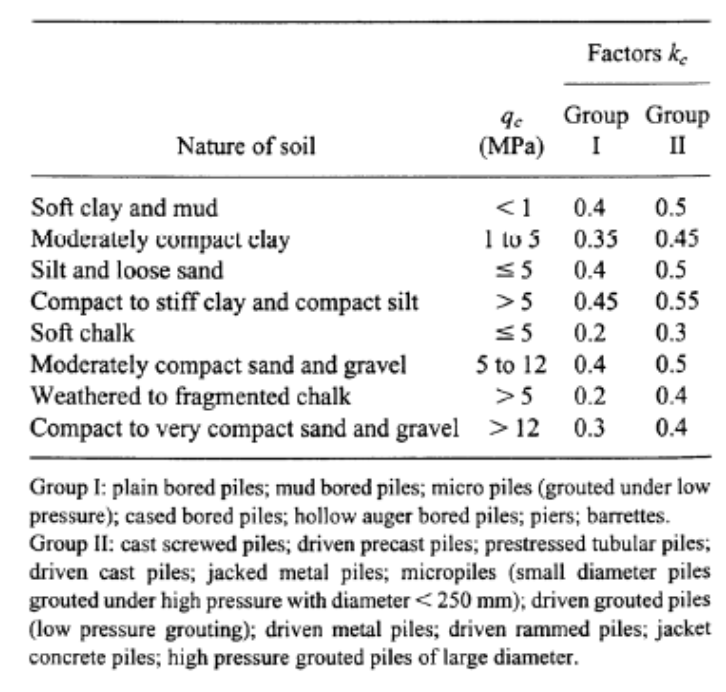
Factors on average cone resistance for base resistance calculation.
- Returns:
Adds columns
"qb [MPa]"and"Qb [kN]"to the dataframe with calculation results.
- calculate_shaft_resistance(careful_execution=False)[source]
Calculates the shaft resistance. A Boolean
careful_executioncan be set toTrueto take the factors for careful execution (default=``False``).The user can enter depth ranges where unit skin friction is ignored.
\[ \begin{align}\begin{aligned}f_s = \min( f_{s,lim}, \frac{q_c}{\alpha_{\text{LCPC}}})\\Q_s = \pi D \int_{0}^{z} f_s(z) dz\end{aligned}\end{align} \]The factors are taken according to the soil and pile type specified.
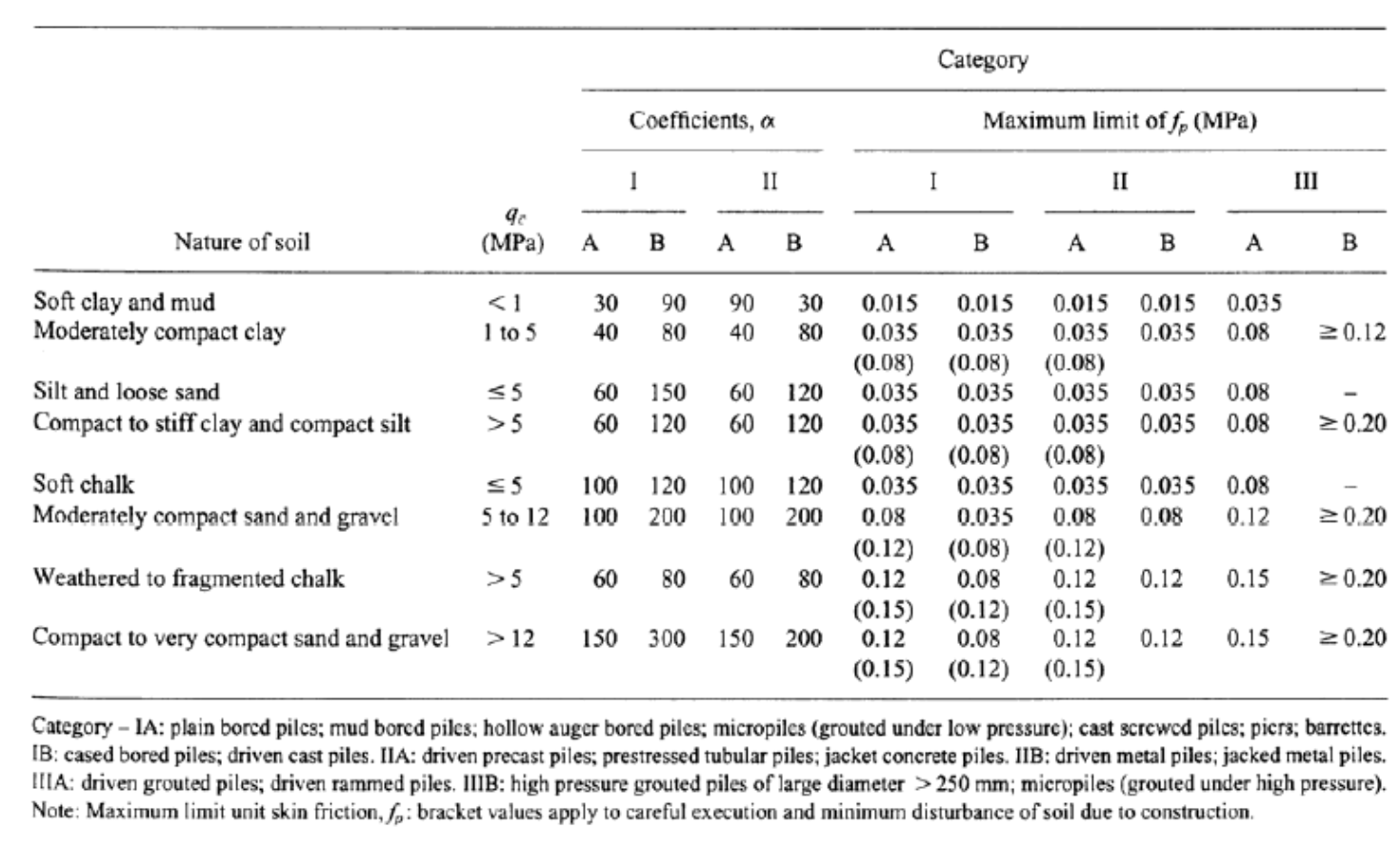
Factors on cone resistance for shaft resistance calculation.
- Returns:
Adds columns
"fs [kPa]","Fs [kN/m]"and"Qs [kN]"to the dataframe with calculation results.
- get_axialpileresistance(pile_penetration)[source]
Returns a dictionary with shaft resistance, base resistance and total resistance at the selected depth.
- plot_axcap(return_fig=False, plot_height=600, plot_width=900, fillcolordict={'Chalk': 'taupe', 'Clay': 'brown', 'Gravel': 'grey', 'Sand': 'yellow', 'Silt': 'orange'}, rs_tick=500, rb_tick=500, rc_tick=500)[source]
Plots the result of the axial capacity analysis
- plot_fs_qb(return_fig=False, plot_height=600, plot_width=700, fillcolordict={'Chalk': 'taupe', 'Clay': 'brown', 'Gravel': 'grey', 'Sand': 'yellow', 'Silt': 'orange'}, fs_lim=(0, 150), fs_tick=20, qb_lim=(0, 30), qb_tick=5)[source]
Plots the profile of unit skin friction and unit end bearing.
- qca_calculation()[source]
Calculates the depth-averaged cone resistance for the LCPC method.
The average cone resistance in an window 1.5OD above and below the considered is calculated. Points which are higher than 1.3 times the average or lower than 0.7 time the average are left out. The average is recalculated using only the left-over points
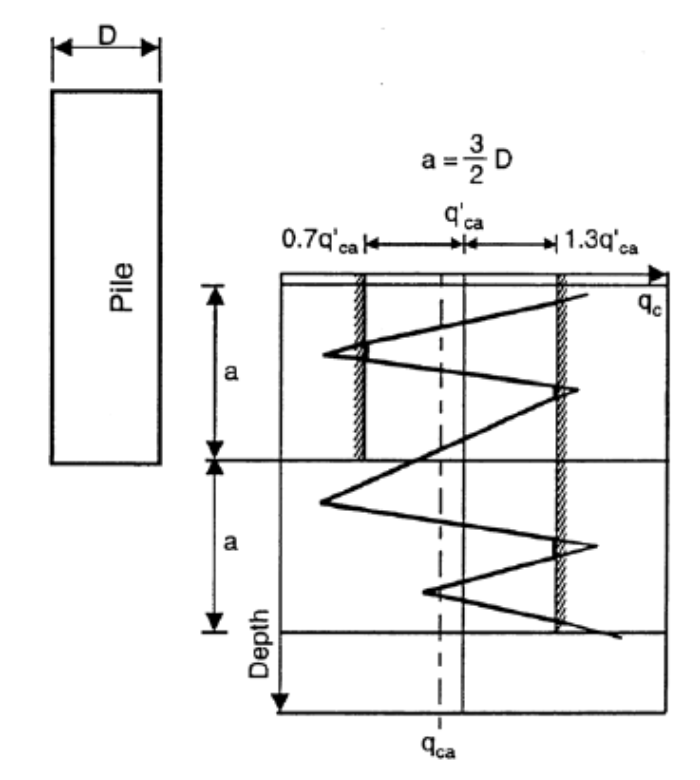
Cone resistance averaging procedure
:returns Stored the average cone resistance for the end bearing calculation in the dataframe with calculation data
- set_soil_layers(soilprofile, soiltypecolumn='Soil type', water_level=0, **kwargs)[source]
Sets the soil type for the pile resistance calculation. For the shaft resistance calculation, a column
"Soil type"is required.The calculation of overburden pressure is included in this routine.
The soil type should be one of the following:
'Clay''Silt''Sand''Chalk''Gravel'
The routine checks the cone resistance at a given depth to check for the soil type according to the LCPC method tables.
- Parameters:
soilprofile – SoilProfile object containing the layer definitions. The SoilProfile should con
soiltypecolumn – Name of the column containing the soil type
water_level – Water level used for the effective stress calculation [m], default = 0 for water level at surface