Stress distributions
- groundhog.shallowfoundations.stressdistribution.stresses_circle(z, footing_radius, imposedstress, poissonsratio, **kwargs)[source]
Calculates the stress distribution below a uniformly loaded circular foundation. The stresses are calculated below the center of the circular foundation
- Parameters:
z – Depth below the base of the foundation (\(z\)) [\(m\)] - Suggested range: z >= 0.0
footing_radius – Radius of the circular foundation (\(r_0\)) [\(m\)] - Suggested range: footing_radius >= 0.0
imposedstress – Applied uniform stress to the circular footing (\(q_s\)) [\(kPa\)]
poissonsratio – Poissons ratio for the soil material (\(\nu\)) [\(-\)] - Suggested range: 0.0 <= poissonsratio <= 0.5
\[ \begin{align}\begin{aligned}\Delta \sigma_z = q_s \left[ 1 - \left( \frac{1}{1 + (r_0 / z)^2} \right)^{3/2} \right]\\\Delta \sigma_r = \Delta \sigma_{\theta} = \frac{q_s}{2} \left[ (1 + 2 \nu) - \frac{4 (1 + \nu)}{\sqrt{1 + (r_0 / z)^2}} + \frac{1}{\left[ 1 + (r_0 / z)^2 \right]^{3/2}} \right]\end{aligned}\end{align} \]- Returns:
Dictionary with the following keys:
’delta sigma z [kPa]’: Vertical stress increase (\(\Delta \sigma_z\)) [\(kPa\)]
’delta sigma r [kPa]’: Radial stress increase (\(\Delta \sigma_r\)) [\(kPa\)]
Reference - Budhu (2011). Soil mechanics and foundation engineering
- groundhog.shallowfoundations.stressdistribution.stresses_lineload_retainingwall(lineload, toe_depth, horizontal_offset, depth, **kwargs)[source]
Calculates the elastic stress increase due to a line load (infinitely long out of plane) next to a buried earth-retaining structure.
- Parameters:
lineload – Magnitude of the applied line load (\(Q\)) [kN/m] - Suggested range: lineload >= 0.0
toe_depth – Depth of the toe of the retaining wall (\(H_0\)) [m] - Suggested range: toe_depth >= 0.0
horizontal_offset – Offset between the line load and the retaining structure (\(a H_0\)) [m] - Suggested range: horizontal_offset >= 0.0
depth – Depth considered for the calculation (cannot be deeper than the toe depth) (\(b H_0\)) [m] - Suggested range: depth >= 0.0
\[ \begin{align}\begin{aligned}\Delta \sigma_x = \frac{4 Q a^2 b}{\pi H_0 \left( a^2 + b^2 \right)^2}\\\Delta P_x = \frac{2 Q}{\pi \left( a^2 + 1 \right)}\end{aligned}\end{align} \]- Returns:
Dictionary with the following keys:
’delta sigma x [kPa]’: Increase of horizontal stress (\(\Delta \sigma_x\)) [kPa]
’delta P x [kN/m]’: Increase of horizontal force (\(\Delta P_x\)) [kN/m]
Reference - Budhu (2011). Soil mechanics and foundation engineering
- groundhog.shallowfoundations.stressdistribution.stresses_pointload(pointload, z, r, poissonsratio, **kwargs)[source]
Calculates the stresses at a point below a line load according the solution proposed by Boussinesq (1885). The vertical stress increase is calculated as well as the increases in radial and tangential stress
- Parameters:
pointload – Magnitude of the point load (\(Q\)) [\(kN\)]
z – Vertical distance from the surface to the point where the stresses are calculated (\(z\)) [\(m\)]
r – Radial distance from the surface to the point where the stresses are calculated (\(r\)) [\(m\)]
poissonsratio – Poisson’s ratio (\(\nu\)) [\(-\)] - Suggested range: 0.0 <= poissonsratio <= 0.5
\[ \begin{align}\begin{aligned}\Delta \sigma_z = \frac{3Q}{2 \pi z^2 \left[ 1 + \left( \frac{r}{z} \right)^2 \right]^{5/2}}\\\Delta \sigma_r = \frac{Q}{2 \pi} \left( \frac{3 r^2 z}{(r^2 + z^2)^{5/2}} - \frac{1 - 2 \nu}{r^2 + z^2 + z \left( r^2 + z^2 \right)^{1/2}}\right)\\\Delta \sigma_{\theta} = \frac{Q}{2 \pi} \left( 1 - 2 \nu \right) \left( \frac{z}{\left( r^2 + z^2 \right)^{3/2}} - \frac{1}{r^2 + z^2 + z \left( r^2 + z^2 \right)^{1/2} } \right)\\\Delta \tau_{rz} = \frac{3 Q}{2 \pi} \left[ \frac{r z^2}{\left( r^2 + z^2 \right)^{5/2}} \right]\end{aligned}\end{align} \]- Returns:
Dictionary with the following keys:
’delta sigma z [kPa]’: Increase in vertical normal stress (\(\Delta \sigma_z\)) [\(kPa\)]
’delta sigma r [kPa]’: Increase in radial normal stress (\(\Delta \sigma_r\)) [\(kPa\)]
’delta sigma theta [kPa]’: Increase in tangential normal stress (\(\Delta \sigma_{\theta}\)) [\(kPa\)]
’delta tau rz [kPa]’: Increase in shear stress in the rz plane (\(\Delta \tau_{rz}\)) [\(kPa\)]

Nomenclature used for point load stress calculation (Budhu, 2011)
Reference - Budhu (2011). Soil mechanics and foundation engineering
- groundhog.shallowfoundations.stressdistribution.stresses_rectangle(imposedstress, length, width, z, **kwargs)[source]
Calculates the stresses under the corner of a uniformly loaded rectangular area. Stresses under other points can be calculated by subdividing the rectangular in smaller sub-rectangles and using superposition stresses (justified because the solution is elastic). E.g. the stresses under the center of a rectangle is calculated by subdividing the rectangle into four equal sub-areas and calculating the stress below the corner of each and summing them.
- Parameters:
imposedstress – Stress applied to the uniformly loaded area (\(q_s\)) [\(kPa\)]
length – Dimension of the longest edge of the rectangle (\(L\)) [\(m\)] - Suggested range: length >= 0.0
width – Dimension of the shortest edge of the rectangle (\(B\)) [\(m\)] - Suggested range: width >= 0.0
z – Depth below the footing (\(z\)) [\(m\)] - Suggested range: z >= 0.0
\[ \begin{align}\begin{aligned}\Delta \sigma_z = \frac{q_s}{2 \pi} \left[ \tan^{-1} \frac{L B}{z R_3} + \frac{L B z}{R_3} \left( \frac{1}{R_1^2} + \frac{1}{R_2^2} \right) \right]\\\Delta \sigma_x = \frac{q_s}{2 \pi} \left[ \tan^{-1} \frac{L B}{z R_3} - \frac{L B z}{R_1^2 R_3} \right]\\\Delta \sigma_y = \frac{q_s}{2 \pi} \left[ \tan^{-1} \frac{L B}{z R_3} - \frac{L B z}{R_2^2 R_3} \right]\\\Delta \tau_{zx} = \frac{q_s}{2 \pi} \left[ \frac{B}{R_2} - \frac{z^2 B}{R_1^2 R_3} \right]\\\text{where}\\R_1 = \sqrt{L^2 + z^2}\\R_2 = \sqrt{B^2 + z^2}\\R_3 = \sqrt{L^2 + B^2 + z^2}\end{aligned}\end{align} \]- Returns:
Dictionary with the following keys:
’delta sigma z [kPa]’: Increase in vertical stress below the corner of the footing (\(\Delta \sigma_z\)) [\(kPa\)]
’delta sigma x [kPa]’: Increase in horizontal stress in the width direction below the corner of the footing (\(\Delta \sigma_x\)) [\(kPa\)]
’delta sigma y [kPa]’: Increase in horizontal stress in the length direction below the corner of the footing (\(\Delta \sigma_y\)) [\(kPa\)]
’delta tau zx [kPa]’: Increase in shear stress in the zx plane below the corner of the footing (\(\Delta \tau_{zx}\)) [\(kPa\)]
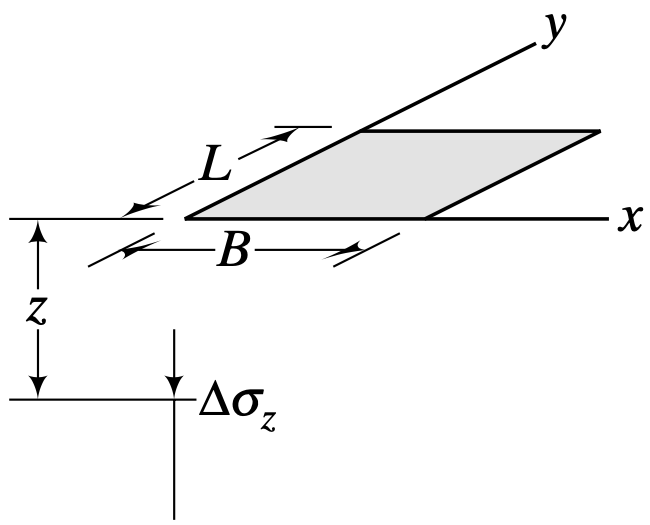
Nomenclature used for calculation of stresses below the corner of a uniformly loaded rectangle
Reference - Budhu (2011). Soil mechanics and foundation engineering
- groundhog.shallowfoundations.stressdistribution.stresses_stripload(z, x, width, imposedstress, triangular=False, **kwargs)[source]
Calculates the stress redistribution at a point in the subsoil due to a strip load with a given width, applied at the surface.
Two cases can be specified. By default, a uniform load is specified, but the stresses under a triangular load can also be calculated.
- Parameters:
z – Vertical distance from the soil surface (\(z\)) [\(m\)] - Suggested range: z >= 0.0
x – Horizontal offset from the leftmost corner of the strip footing (\(x\)) [\(m\)]
width – Width of the strip footing (\(B\)) [\(m\)] - Suggested range: width >= 0.0
imposedstress – Maximum value of the imposed force per unit area (\(q_s\)) [\(kN/m^2\)]
triangular – Boolean determining whether a triangular load pattern is applied (optional, default= False)
\[ \begin{align}\begin{aligned}R_1 = \sqrt{x^2 + z^2}\\R_2 = \sqrt{(x - B)^2 + z^2}\\\cos \left(\alpha + \beta \right) = z / R_1\\\cos \beta = z / R_2\\\text{Uniform load}\\\Delta \sigma_z = \frac{q_s}{\pi} \left[ \alpha + \sin \alpha \cos \left( \alpha + 2 \beta \right) \right]\\\Delta \sigma_x = \frac{q_s}{\pi} \left[ \alpha - \sin \alpha \cos \left( \alpha + 2 \beta \right) \right]\\\Delta \tau_{zx} = \frac{q_s}{\pi} \left[ \sin \alpha \sin \left( \alpha + 2 \beta \right) \right]\\\text{Triangular load}\\\Delta \sigma_z = \frac{q_s}{\pi} \left( \frac{x}{B} \alpha - \frac{1}{2} \sin 2 \beta \right)\\\Delta \sigma_x = \frac{q_s}{\pi} \left( \frac{x}{B} \alpha - \frac{z}{B} \ln \frac{R_1^2}{R_2^2} + \frac{1}{2} \sin 2 \beta \right)\\\Delta \tau_zx = \frac{q_s}{2 \pi} \left( 1 + \cos 2 \beta - 2 \frac{z}{B} \alpha \right)\end{aligned}\end{align} \]- Returns:
Dictionary with the following keys:
’delta sigma z [kPa]’: Increase in vertical stress due to surface load (\(\Delta \sigma_z\)) [\(kPa\)]
’delta sigma x [kPa]’: Increase in horizontal stress due to surface load (\(\Delta \sigma_x\)) [\(kPa\)]
’delta tau zx [kPa]’: Increase in shear stress due to surface load (\(\Delta \tau_{zx}\)) [\(kPa\)]
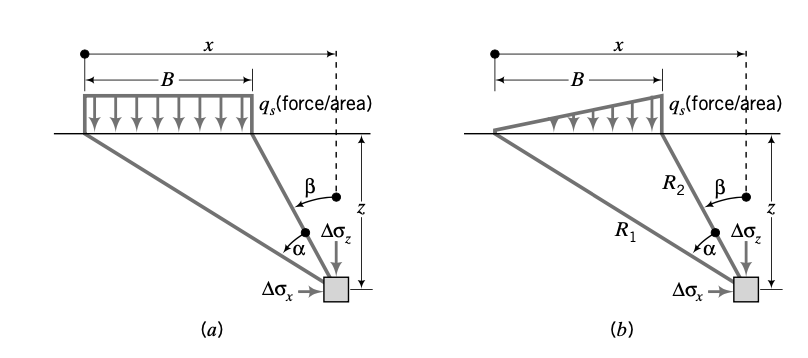
Nomenclature for inputs in stress calculation due to a strip footing
Reference - Budhu (2011). Soil mechanics and foundation engineering
- groundhog.shallowfoundations.stressdistribution.stresses_stripload_retainingwall(imposedstress, width, offset, toe_depth, depth, **kwargs)[source]
Calculates the elastic stress increase due to a strip load (infinitely long out of plane) at an offset from a buried earth-retaining structure.
Note that all angles in the formulae are given in degrees.
- Parameters:
imposedstress – Applied stress for the strip load (\(q_s\)) [kPa] - Suggested range: imposedstress >= 0.0
width – Width of the strip load (\(B\)) [m] - Suggested range: width >= 0.0
offset – Shortest horizontal offset between the strip load and the retaining wall (\(a\)) [m] - Suggested range: offset >= 0.0
toe_depth – Toe depth of the retaining structure (\(H_0\)) [m] - Suggested range: toe_depth >= 0.0
depth – Depth for the stress calculation (\(z\)) [m] - Suggested range: depth >= 0.0
\[ \begin{align}\begin{aligned}\Delta \sigma_x = \frac{2 q_s}{\pi} \left( \beta - \sin \beta \cos 2 \alpha \right)\\\Delta P_x = \frac{q_s}{90} \left[ H_0 \left( \theta_2 - \theta_1 \right) \right]\\\bar{z} = \frac{H_0^2 \left( \theta_2 - \theta_1 \right) - \left( R_1 - R_2 \right) + 57.3 B H_0}{2 H_0 \left( \theta_2 - \theta_1 \right)}\\\theta_1 = \tan^{-1} \left( \frac{a}{H_0} \right)\\\theta_2 = \tan^{-1} \left( \frac{a + B}{H_0} \right)\\R_1 = \left( a + B \right)^2 \left(90 -\theta_2 \right)\\R_2 = a^2 \left( 90 - \theta_1 \right)\end{aligned}\end{align} \]- Returns:
Dictionary with the following keys:
’delta sigma x [kPa]’: Increase of the lateral stress (\(\Delta \sigma_x\)) [kPa]
’delta P x [kN/m]’: Increase of lateral force (\(\Delta P_x\)) [kN/m]
’z bar [m]’: Application depth of the force (\(\bar{z}\)) [m]
’theta 1 [deg]’: Angle theta 1 (\(\theta_1\)) [deg]
’theta 2 [deg]’: Angle theta 2 (\(\theta_2\)) [deg]
’R 1 [m]’: First offset (\(R_1\)) [m]
’R 2 [m]’: Second offset (\(R_2\)) [m]
’alpha [deg]’: Angle alpha (\(\alpha\)) [deg]
’beta [deg]’: Angle beta (\(\beta\)) [deg]
Reference - Budhu (2011). Soil mechanics and foundation engineering